
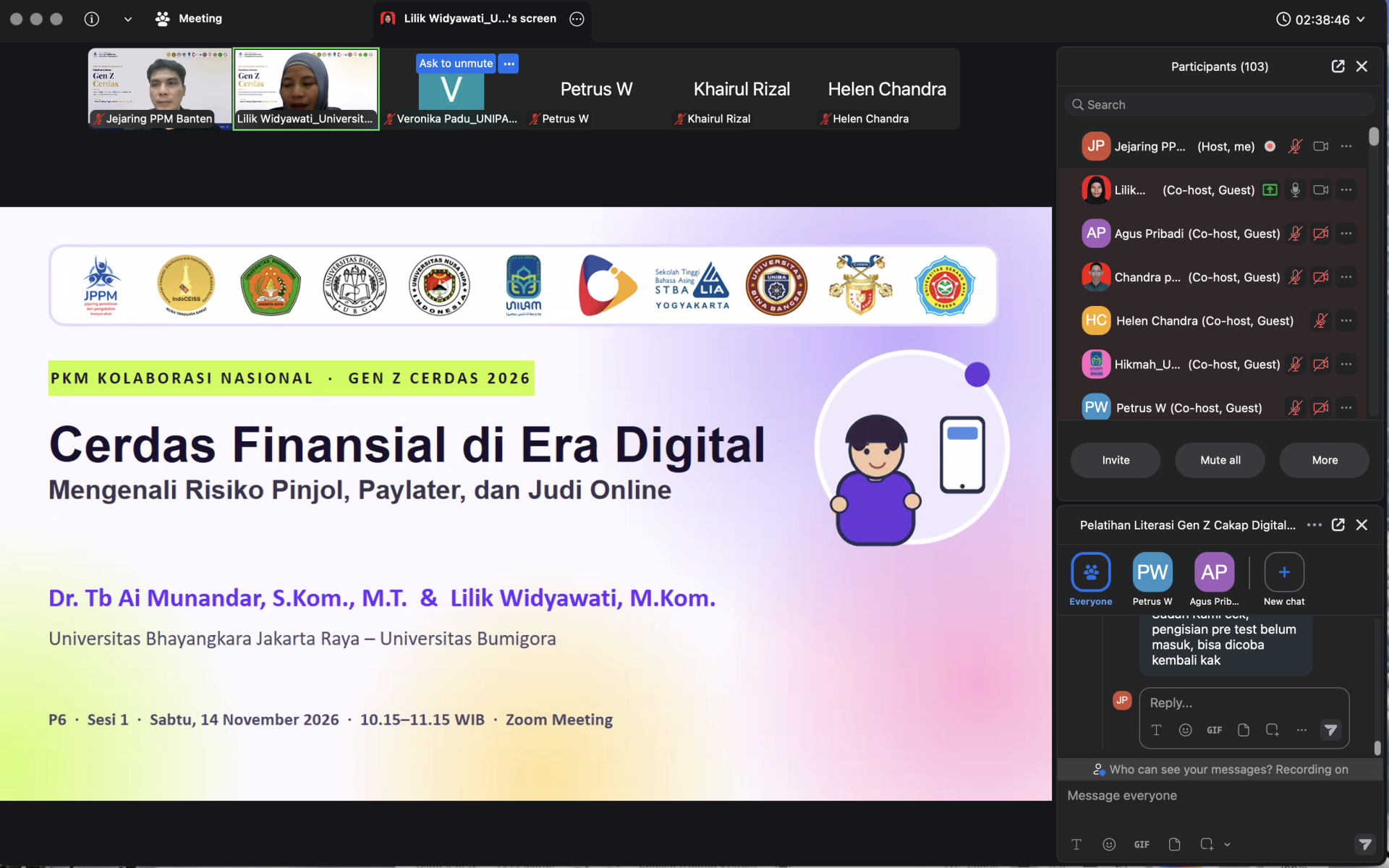
The widespread use of online loans (pinjol), paylater services and online gambling among the younger generation is a concern in the Smart Gen Z Literacy Training activities. Through the third National Collaboration Community Service (PkM) session III, participants were invited to recognize various digital financial pitfalls that could have an impact on data security, economic conditions and their future. The activity, which was initiated by the Research and Community Service Network (JPPM) together with collaborating universities, was carried out online via Zoom Meeting on November 14 2026. A total of 103 participants took part in this activity out of a total of 208 people who registered.
With the theme "Resolving the Risks of Online Loans, Paylater and Online Gambling for Students" , this session presented two academics in the field of informatics, namely Dr. Tb Ai Munandar, S.Kom., MT from Bhayangkara University, Greater Jakarta and Lilik Widyawati, M.Kom. from Bumigora University. Both present complementary scientific perspectives in discussing this issue. Dr. Tb Ai Munandar, who also serves as Chair of JPPM, has a background in computer science and is active in developing research activities and community service through inter-campus collaboration.
Meanwhile, Lilik Widyawati has been a permanent lecturer in the Informatics Study Program at Bumigora University since 2019. With expertise in data and information security, especially cryptography and steganography, she is also active in researching network security, malware analysis, and digital forensics. Lilik is a graduate of the University of Muhammadiyah Malang and the Islamic University of Indonesia and holds the Certified Ethical Hacker (CEH) certification. In his presentation, participants were introduced to various offering modes that often appear in the digital space. Starting from loan promotions with an instant disbursement process, ease of transactions using paylater, to the promise of big profits through online gambling. An offer that looks profitable can actually be the doorway to more complex financial problems.
One thing that is of concern is consumer behavior which is influenced by social media trends. The phenomenon of FOMO and flexing can make students feel the need to follow a certain lifestyle so as not to be left behind by their social environment. As a result, decisions to buy goods are no longer based on need, but on the desire to gain social recognition. Participants then received an explanation of the characteristics of legal and illegal online loan services. The difference between the two lies not only in licensing status, but also in cost transparency, service provisions and personal data protection. Illegal Pinjol risks misusing user information, especially when the application requests access to the phone's contact list and gallery. This data can even be used as a means of intimidation in billing practices.
To provide a more concrete picture, the resource person used a loan simulation of IDR 1 million. Through these illustrations, participants can understand how loan costs and repayment terms affect the amount of obligations that must be covered. Paylater services are also an important part of the discussion. The ease of buying goods now and paying for them later requires an understanding of interest, fines and ability to pay. The resource person reminded that payment obligations that are not managed properly could have an impact on the credit record in the OJK SLIK and could potentially become an obstacle when someone applies for financing in the future.
Not stopping at the issue of loans, this session also explores the patterns that make online gambling difficult to abandon. Winning at the start of the game, the thrill of almost winning a prize, and the desire to recover the money you have lost are some of the factors that can encourage someone to continue playing. Participants were also introduced to PPATK data regarding the turnover of online gambling funds and the involvement of children and youth age groups. The impact is not only in the form of material loss. Dependence on online gambling or loan bondage can trigger family conflicts, disrupt education, damage social relationships, and give rise to legal consequences.
To make the material easier to understand, the resource person presented two illustrations of problems that are close to the lives of the younger generation. The first illustration depicts a student named Raka who uses his older brother's paylater to buy a cellphone. When he had difficulty paying, he sought additional loans through illegal services. The problem became more serious after family members' data was misused for billing purposes. The next illustration shows Dinda, a student who was initially interested in trying online gambling because he was tempted by a winning promotion. The initial profits made him continue playing until the money for housing supplies ran out. In an effort to recover his losses, he actually took out loans from several applications.
These two illustrations became material for interactive discussion. Participants are invited to examine decisions that cause problems to become bigger, recognize early signs of financial dependency, and determine steps that can be taken before the situation becomes more difficult. As a practical provision, the resource person introduced the STOP method to help participants deal with suspicious digital invitations or offers. This method includes four steps: stopping for a moment ( Stop ), looking for information and conducting an examination ( Ask and check ), discussing the problem with a trusted person ( Talk to a trusted person ), and determining a safer choice ( Choose an alternative ).
Participants are also directed to use official channels if they encounter problems related to financial services or problematic digital content, including OJK Contact 157 and aduankonten.id. Participants' understanding is then tested through a short quiz. One of the indicators discussed is a loan application that asks for permission to access all contacts and the device gallery, which should be suspected of being an illegal lending practice. Through this activity, the two lecturers emphasized the importance of building digital awareness from an early age. It is not enough for students to just be able to use technology, but also need to understand the risks behind the services they use. The ability to recognize fraud modes, protect personal data, control consumer behavior, and make wise financial decisions is an important part of the digital literacy of the younger generation.